City Modelling
From Raw Data to Usable 3D City Models
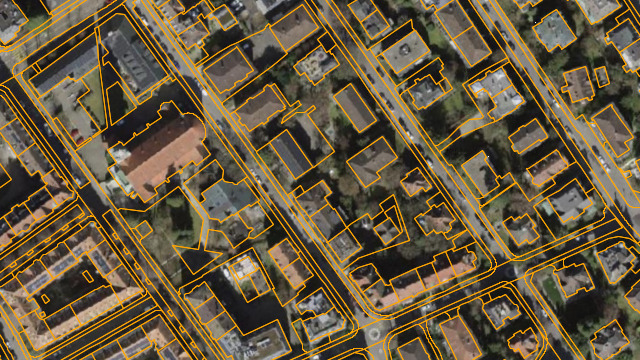
Cities and organizations today have access to vast amounts of geospatial data - but turning that data into something usable remains a challenge. Point clouds, raster layers, and building footprints provide a rich foundation for extracting meaningful insights and creating reliable 3D representations. LIS Pro 3D enables the transformation of these raw inputs into structured, high-quality 3D building models that support real-world applications.
With its City Modeller, LIS Pro 3D not only reduces complexity but also increases confidence in the results. Data is aligned, validated, and prepared to ensure that buildings are fully represented and ready for analysis. The result is a solid foundation for deriving meaningful urban insights and consistently generating accurate, application-ready 3D building models.
Creating Reliable 3D Building Intelligence
LIS Pro 3D allows the transformation of raw data into detailed 3D building models. This is where the real impact becomes visible. Buildings are no longer just footprints on a map - they become structured objects with geometry, attributes, and measurable properties.
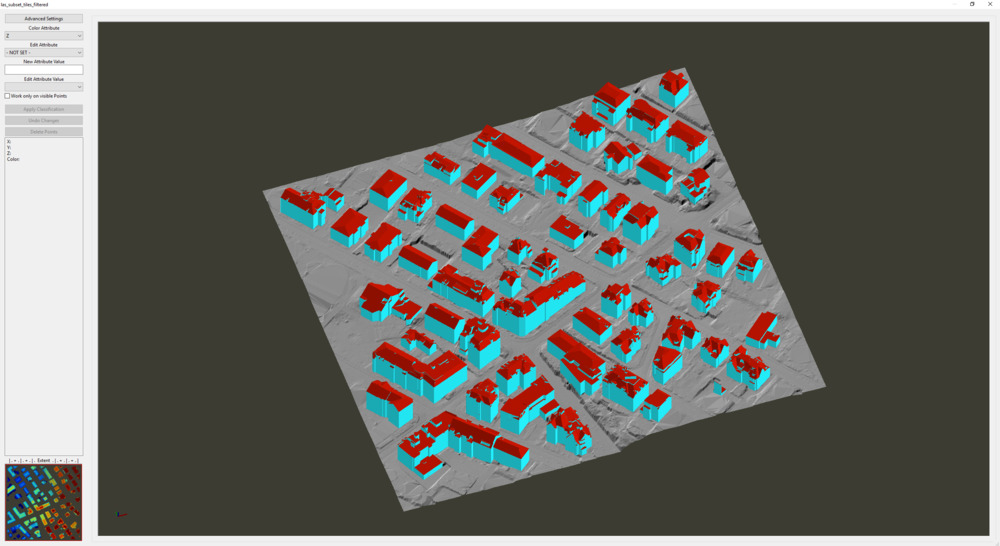
Based on point cloud data and building footsprints, LIS Pro 3D allows the derivation of LOD2 (Level of Detail 2) building models by identifying roof structures, calculating their characteristics and assembling them into coherent models. These models strike a powerful balance between detail and efficiency, making them suitable for a wide range of applications - from urban planning and energy analysis to visualization and digital twins.
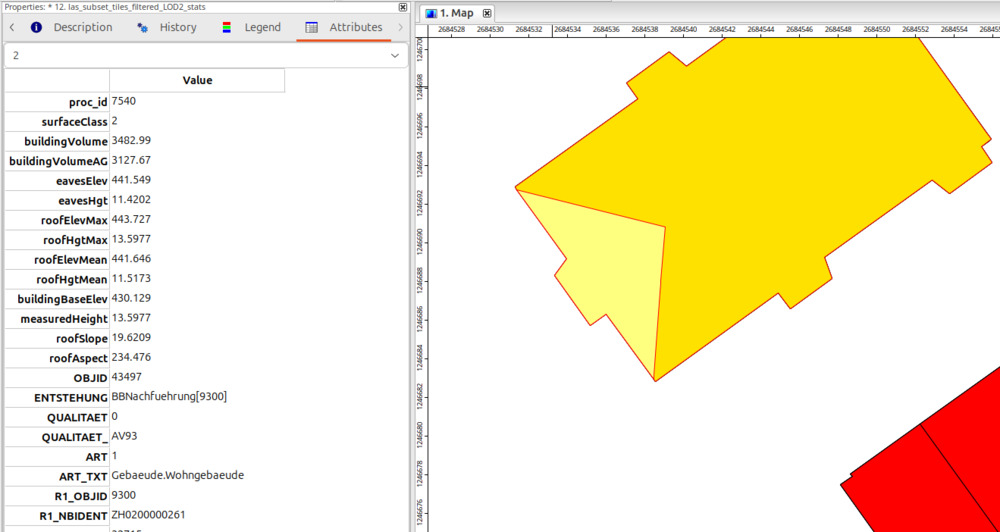
Beyond geometry, the ability to derive building-level statistics adds another layer of value. LIS Pro 3D makes it possible to compute key attributes such as slope, aspect, and mean or maximum height for individual roof segments, as well as more detailed metrics like eaves height. These are just starting points - thanks to LIS Pro 3D’s flexible design, it is simple to generate a wide range of additional, application-specific variables for your building and roof models. The result is not just a 3D model, but a rich, information-driven dataset that is ready for integration into downstream systems through standard formats.
Scaling 3D City Model Generation
Perhaps the greatest advantage of this approach is its scalability. What begins as a structured method for handling individual datasets through LIS Pro 3D’s GUI can seamlessly evolve into a fully reproducible pipeline thanks to its scripting capabilities. Once automated, the same processing steps can be applied across entire cities or regions with minimal manual effort, enabling efficient and consistent large-scale 3D model generation.
This enables your organization or lab to move from one-off projects to continuous, repeatable production of 3D city models. The result is a consistent, efficient workflow that supports long-term use cases and growing data demands - unlocking the full potential of geospatial data at scale.
Start Learning Today
Explore the city modeller tutorial and see how easy it is to derive building models from your point cloud data.
- Request your free LIS Pro 3D trial here
- Get started with our tutorial on City Modelling with LIS Pro 3D